
How to reduce RTO on COD orders with 30-minute delivery
30 September 2026 · Shaheer Ahmed
A COD order comes in at 11 pm. Three days later, the courier reaches the door and the buyer says, "I don't want it anymore." You have now paid to ship the parcel out, and you will pay to get it back.
If you want to reduce RTO on COD orders, start there. Not with the buyer, but with the gap between the click and the doorstep.
You pay twice for a sale that never happened
When a courier returns a parcel to origin (RTO), the brand pays the forward charge and then the return charge. One large courier bills the return at about 80-100% of the forward freight, which effectively doubles shipping spend on that order. Add a COD fee (as reported for one large courier, Rs 40-50 or 2% of order value, whichever is higher) and the picture gets worse.
Freight is only part of it. Amazon Shipping India, citing Pragma, puts the all-in cost of one RTO at Rs 180-240 once you count handling and the stock sitting idle. Pragma also notes that a failed shipment can spend far longer in the network than a delivered one, so that inventory is not available to sell.
| What you pay on one COD RTO | How much | Source |
|---|---|---|
| Forward shipping | The full forward freight | |
| Return shipping | About 80-100% of the forward freight | ClickPost |
| COD fee | Rs 40-50 or 2% of order value, whichever is higher | ClickPost |
| All-in cost, with handling and idle stock | Rs 180-240 | Amazon Shipping India, citing Pragma |
| Revenue from the sale | Nothing |
So an RTO is a cost for a sale that never happened. Nothing came in, and money went out twice.
How big is COD RTO in India, really?
Bigger than most founders like to admit. In Shipway's FY25 data, under 2% of prepaid orders came back, against about 26% of COD orders. That is roughly one in four COD orders.
It also swings with the season. Unicommerce's D2C data shows RTO peaking at 39.2% in November and falling to 21.0% by March, after brands that added prepaid incentives, pin-code-based courier routing and address checks. So RTO is not fixed. It responds to what you change.
A word of caution: many RTO numbers floating around the internet have no source. One analysis points out that most of the figures vendors quote are not sourced at all. I have only used numbers I could link.
Why COD buyers say no at the door
The usual suspects are wrong addresses, nobody being home, and buyers who can't be reached. Velocity found that 30-35% of COD segments did not respond to confirmation.
But there is one more reason, and it's toughest to fix: the buyer simply changed their mind.
We are a logistics company, not the brand, yet at least three times COD customers have called us assuming we were the brand. Asking whether the product is legit. They were still deciding, even though the order was already placed. In all three cases the order was delivered and the cash was collected.
Our delivery executives tell the similar stories. A customer opens the door and says something like: I was still thinking about it, but it's already here, ok, let me try it. We haven't recorded these word for word, but the pattern is clear.
That clearly tells me something we have been getting wrong while looking at Ads Manager dashboards and Shopify reports. A COD order is NOT a conversion (marketing folks, listen closely). It is an impulse that hasn't been confirmed yet, and many buyers are still in the consideration stage.
(Having said all this, I do admit there is an exception: a certain breed of COD customers who will return it, no matter what. "Jisko RTO karna hai, woh kar ke hi rahega". Maybe we should classify them more rightly as serial returners, not COD, and definitely not a customer)
The clock is the real enemy
The best public evidence we have is, again, the Shipway data. RTO rises with delivery time: 22% when delivery is attempted in 1-2 days, 27% in 3-5 days, and 35% after 5 days.
Even within the same city, intra-city courier shipments in that dataset still saw about 20% RTO. So short distance alone doesn't fix it. What seems to matter is how much time passes between the order and the doorstep.
Every extra day gives the buyer a chance to cool off, compare prices, or find the same thing cheaper.
What happens when delivery takes 30 minutes
The public data stops at 1-2 days. I am not aware of any public study on delivery within an hour, so I can only share what we see ourselves.
Across our Bangalore deliveries from January to September 2026, COD RTO has been under 5%, against an industry figure of ~25%, roughly one in four. Total RTO, prepaid and COD together, has been under 0.5%. I'm not able to share order counts, so take that as our own observation, not a study.
Our explanation is simple. With 30-minute delivery, the buyer has very little time to change their mind, look at competitor products, or let the impulse fade. By the time the doubt shows up, the rider is at the door.
Why we don't charge for returns
We don't charge any extra RTO fee, and that is our policy for every brand.
The reason is how the trip works. A courier parcel that comes back has to travel from the destination city through multiple hubs and back to the origin city. In a dark-store model like ours, the shipment moves only a few kilometres, and the rider was making that trip anyway. The return leg costs us close to nothing, so we don't bill for it.
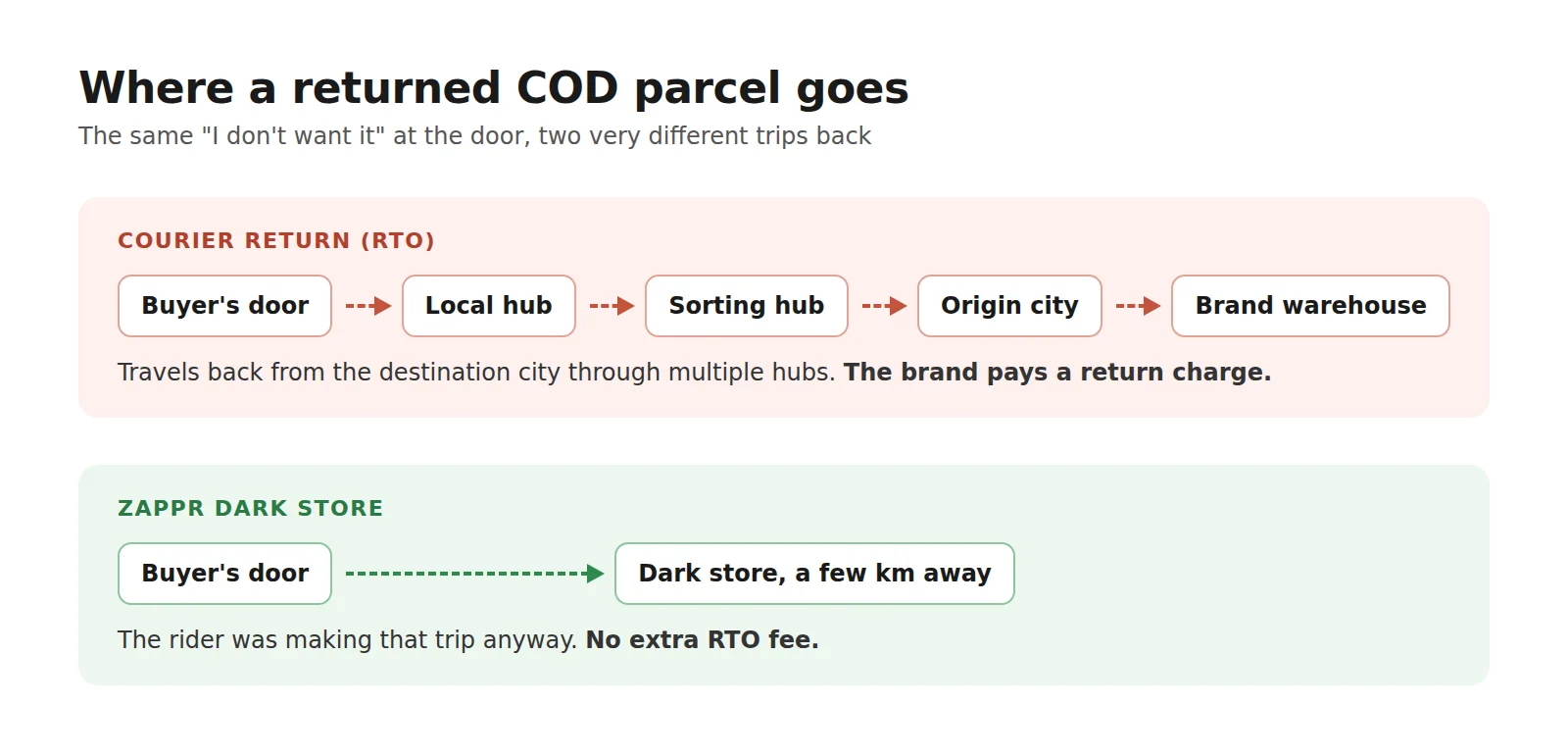
We are also considering not charging for a COD order if it isn't delivered. Not something we offer today (Sept. 30, 2026, as I write this), but actively working on it.
Five ways to reduce RTO on COD orders this week
You can't always switch to 30-minute delivery by Friday. You can do these:
- Measure your own COD RTO. Split it by delivery time, pin code and courier. You can't fix what you only guess at.
- Shorten the gap. Look at how long your slowest pin codes take. The Shipway numbers show RTO climbing with every extra day in transit.
- Confirm fast. Reach out to COD buyers within minutes, not the next day. Expect that many won't reply.
- Nudge prepaid. Unicommerce's data shows brands pulling RTO down with prepaid incentives and address checks.
- Act on failed deliveries within 24 hours. Call the buyer, fix the address, and reattempt before the order goes cold.
Point no. 6 (My own opinion, not proven): Consider every COD order not as a conversion, but still at the bottom of the funnel. And continue the retargeting and marketing campaigns until actually delivered.
Where I'd start
If your COD RTO is near one in four, I'd fix the delay before I start screening buyers. Time is the factor you control, and the data points the same way.
We're still learning here, and I don't claim 30 minutes solves everything. If you'd like to talk through your own COD numbers, you can book a call at zappr.delivery, or see how our pricing works.
Sources
- Shipway analyses key drivers behind India's e-commerce RTOs (ShipNotes FY25), via The Home Fashion, 31 Jul 2025
- India D2C Report 2026, Unicommerce, Apr 2026
- Delhivery courier charges, ClickPost, updated 18 Sep 2026
- What is RTO and how to reduce it, Amazon Shipping India, 12 Jun 2026
- RTO rates KPI, Pragma, 26 Oct 2025
- AI helps D2C brands improve delivery completion rates (Velocity data), CIO&Leader, 7 Apr 2026
- COD verification and RTO numbers in India, Botsense, 4 Aug 2026