
Own D2C quick delivery vs a shared stack: what Libas, Snitch, and Supertails chose
3 October 2026 · Shaheer Ahmed
Libas says it will launch "our own D2C quick commerce" before the festive season. Snitch already promises 60-minute delivery. If you run a D2C brand, the question lands in your mind: "am I falling behind if I don't build this too?"
I spend my days running a 30-minute logistics business for D2C brands in Bangalore, so I looked at how brands actually run D2C quick delivery. TL;DR. it depends on your size, and most brands are less "own it all" than what general headlines suggest.
Own D2C quick delivery: what the big brands actually built
Libas (ethnic wear) will start in Delhi, Bengaluru and Mumbai, per its CEO. This is in addition to being available on M-Now & Instamart. It closed FY26 at about Rs 730 Cr.
Earlier, it planned to link 30-40% of its retail stores with dark stores with inventory moving between them on demand. Who runs the fleet isn't known, but I can make a confident guess it's outsourced to pure last-mile operators.
Snitch (menswear) piloted 60-minute delivery in Bengaluru, fulfilled from its retail stores acting as pseudo dark-stores and delivered by last-mile partners. It had 55+ stores and FY25 revenue above Rs 500 Cr at launch.
By April this year, Snitch Quick was live in four cities: Bengaluru, Delhi, Gurugram and Ahmedabad, with Hyderabad and Mumbai upcoming. Quick delivery was already ~10% of its online revenue. They closed FY26 at Rs 900 Cr with 115 stores.
Supertails (pet care) runs 45 partner-operated dark stores across three cities. Supertails keeps inventory, tech and the customer relationship, and 3rd party operators run the stores and fleet. These stores are dedicated to Supertails, not shared. The quick delivery vertical has grown in double digits MoM.
Mosaic Wellness (Man Matters, Be Bodywise) uses a fully 3rd-party managed setup - dark-stores and fleet. However, for warehousing, most large brands mostly have inventory distributed regionally, usually in NCR, Mumbai (Bhiwandi), and Bangalore (Nelamangala), what I like to call as the "BDM" belt.
Archies (gifting) says its own D2C platform delivers in about 1.5-3 hours. Who runs those deliveries isn't public, so I'll leave it there.
Three ways to run it
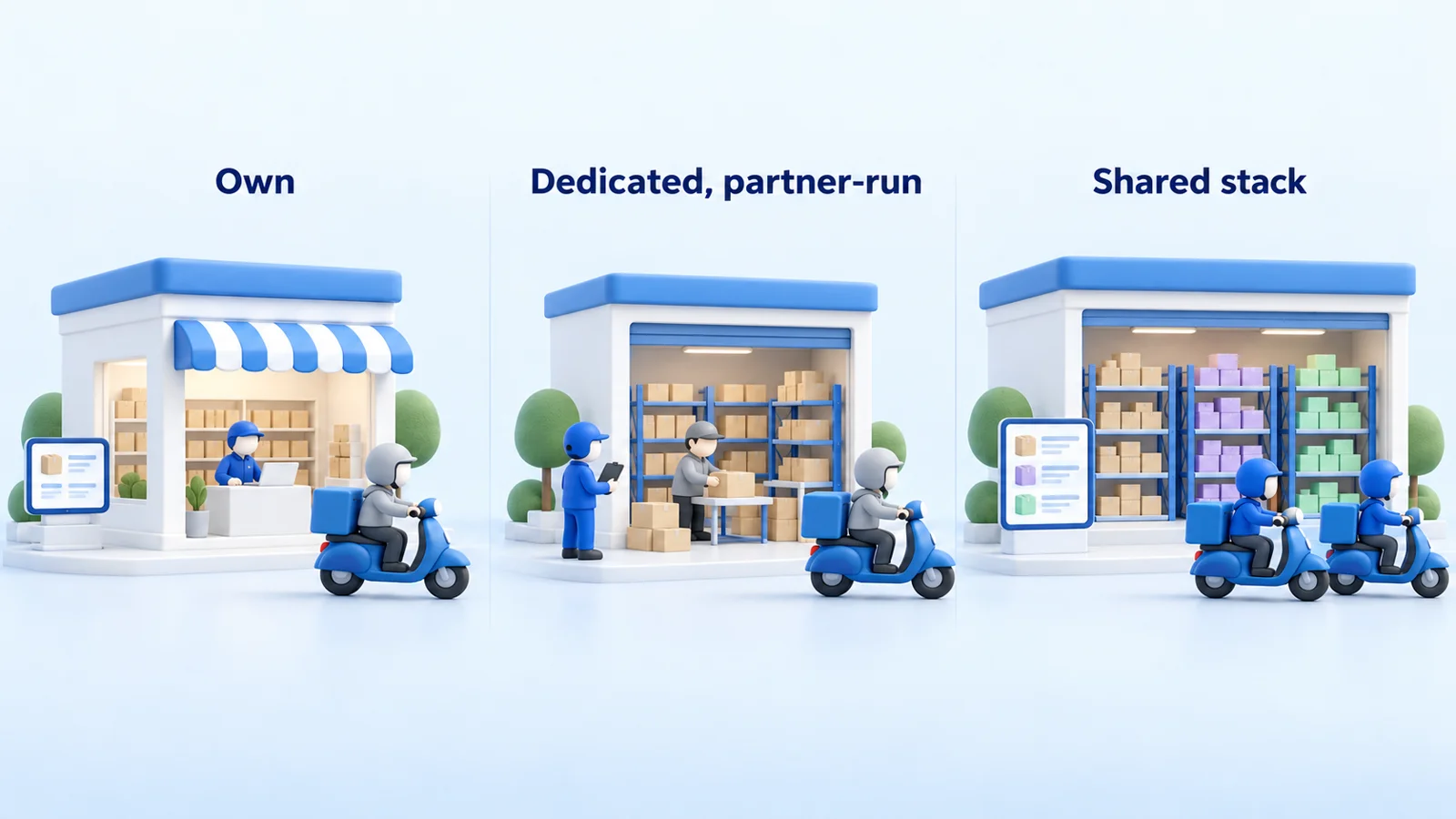
Put these together and you get three models:
- Own: your stores or dark stores, your stock, usually your own tech. Libas and Snitch sit here.
- Dedicated, partner-run: a logistics partner operates stores that serve only you. Supertails sits here.
- Shared stack: one dark store, one rider pool and one tech layer, used by many brands. This is what we run at Zappr.
Even in the "own" model, the pattern is that brands own stock and stores, while the delivery leg seems to go to partners. Nobody in D2C runs everything alone.
Other than the 3 above, there is one breed of brands that do EVERYTHING owned - even last-mile and tech. Think Licious or FreshToHome; or Akshayakalpa for milk runs. But these are more a necessity, than a choice, due to unique operational & technical constraints that usually don't fit with a one-size-fits-all offering of 3PLs.
What a dark store really costs
Dark stores are the rage right now in the logistics world, and they're getting pricier. Per a UBS report, Blinkit and Instamart raised their capex estimate per dark store to about Rs 2.5 Cr, from about Rs 1 Cr two years ago, and Rs. 80L before that. A 2,500-3,000 sq ft store now costs about Rs 1.4-1.6 Cr.
Throughput is what makes that pay off. Blinkit's stores average about Rs 8.27 lakh of order value a day, across thousands of SKUs from many brands. A brand in a single category rarely has that.
Why speed is expensive for a single brand
Delhivery's CEO Sahil Barua explains it well on an earnings call. Orders arrive at random, so you either get "exponential delays", or you have to overstaff. The classic supply-demand matching problem that plagues every hyperlocal logistics business.
That hits a single brand hardest, because one brand's orders are lumpy. Riders could wait around between them. Pooling multiple brands' orders onto the same riders and shared stores is the usual way to fix that.
It's the reason we built Zappr the way we did.
Bangalore adds a rule too. Karnataka's gig-worker welfare fee has been in force since 13 February 2026, at 1% of payouts for platforms and aggregators. I'm not sure how it applies to a brand hiring riders directly, which is a good example of the legal work fleets bring along.
Which model fits which brand
- Large brands, roughly Rs 500 Cr+ in revenue, with dozens of stores per city (large fast fashion, for example): exploring dedicated or own dark stores can make sense. Their retail stores already exist, and their order density is high enough to keep a infra busy.
- Everyone else: shared infrastructure (dark store + fleet) is almost always the better fit, because the cost and effort of building in-house are high.
Zappr offers the complete stack, from tech to dark store to fleet, and suits brands with Rs 0-100 Cr in revenue. Brands like The Whole Truth, Unived, and Clapstore Toys use it.
Even at Libas's scale, quick commerce is a small, growing channel: under 1% of revenue last year and 3-4% in FY27. For a smaller brand, spending crores on your own stack for it is a hard sell.
What a D2C brand can do this month
- Check your orders by pincode. See where your customers cluster in the BDM (Bangalore, Delhi, Mumbai) belt. A few dense areas matter more than the whole city.
- Decide what you want to promise. A 30-60 minute promise on your own site is a conversion and customer-experience tool, not an infrastructure project.
- Ask any partner what they own and what they rent. Stores, riders, tech. Prefer vendor-owned in this order: riders, store, tech. Going for a pure tech solution / aggregator is usually a bad choice when you have physical inventory involved.
- Keep the customer. Selling only on quick-commerce apps means the app sets the economics and owns the relationship. Delivery from your own site keeps both with you.
Most times, young or newly launched D2C brands do not have enough order density to test quick delivery. Being a young startup ourselves, we decided to onboard brands of any size, with zero minimum order quantity (MOQ) for the first 3 months, and kept it as low as possible from Month 4. That way we create a level-playing field for all brands to access "quick commerce".
Where I'd start
Don't fall for the headline. In my experience, I have first-hand seen even large brands struggle with building own infra, and eventually handing over to a 3PL. Libas and Snitch have hundreds of crores in revenue and stores already in place, and they are doing the right thing at their scale. If you are smaller, rent the stack.
I'm still learning where the lines fall, and I don't think this is one-size-fits-all. If you want to talk through your own numbers, you can book a call at zappr.delivery, or see how our pricing works.
Sources
- Libas to launch D2C quick commerce platform ahead of festive season, Storyboard18, 25 Sep 2026
- Libas eyes 2x festive revenue jump, targets Rs 1,000 Cr in FY27, Storyboard18, 25 Sep 2026
- Libas to integrate 40% EBOs with dark stores, Storyboard18, 2 Aug 2025
- D2C brands race into quick delivery as festive shopping moves to 60-minute commerce, Storyboard18, 30 Sep 2026
- Snitch forays into quick commerce with 60-minute delivery, Inc42, 29 Oct 2025
- Snitch's FY26 revenue surges 80% to Rs 900 Cr, Inc42, 10 Apr 2026
- Supertails has built the pet care ecosystem, Inc42, 25 Aug 2026
- Quick commerce expands: dark stores grow larger, costlier, Storyboard18 (citing UBS), 4 Sep 2026
- Takeaways from Eternal Q1 FY27 earnings call, MediaNama, 24 Jul 2026
- Delhivery Q1 FY27 earnings call transcript, 8 Aug 2026
- Karnataka notifies gig workers welfare fee, SCC Online, 18 Feb 2026