
Delivery in the q-com era: why D2C brands need multiple partners, not one
14 October 2026 · Shaheer Ahmed
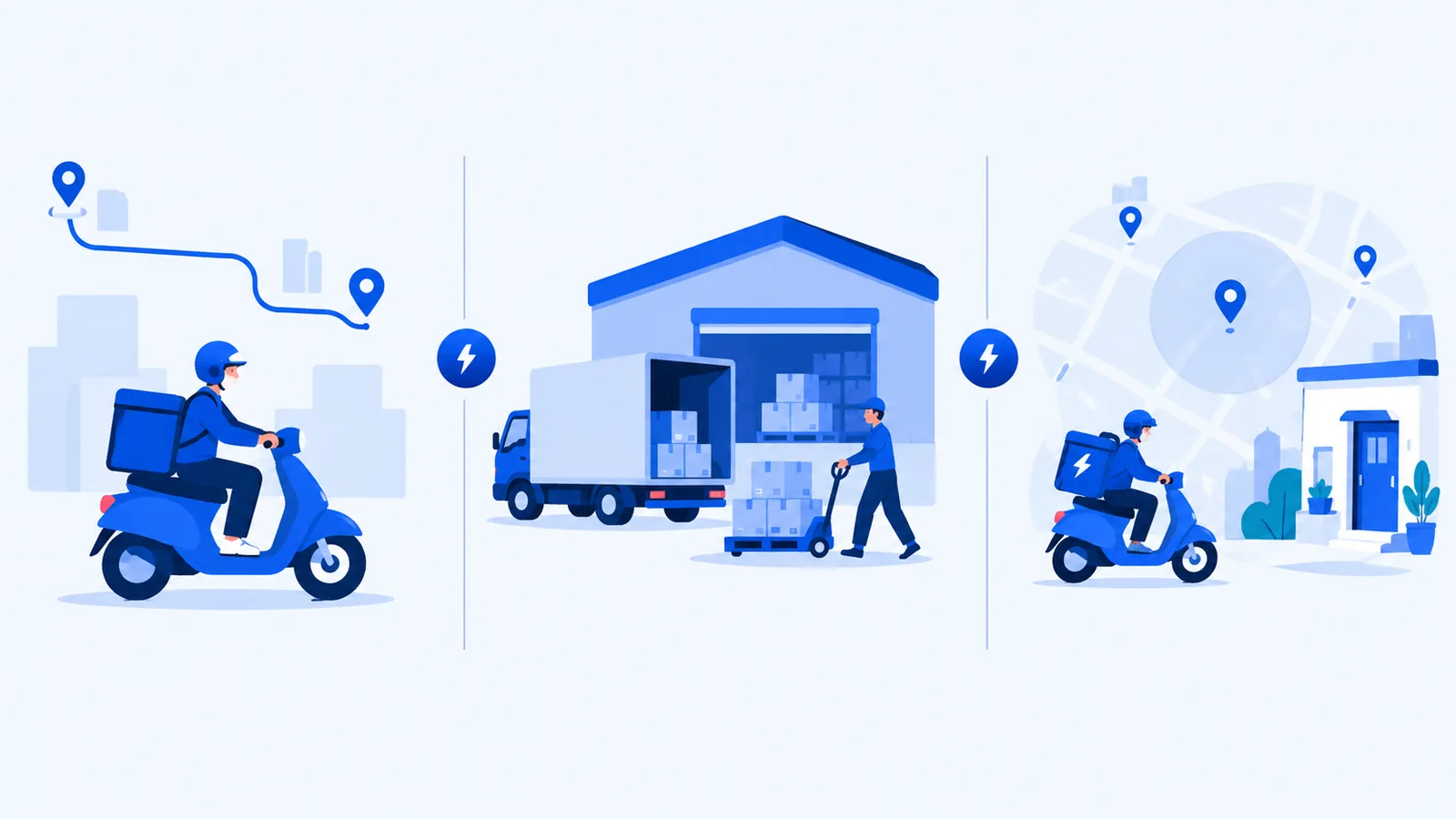
Pull your D2C orders of last 30 days, sort them by pincode, and check how many came from Bengaluru. For most brands, it's a big chunk.
That one number should change how you think about courier vs 3PL vs hyperlocal delivery. Most D2C "gurus" advice is to start with an aggregator like Shiprocket, then go direct once you have volumes. That's good advice, if you were building your brand in 2019 :)
If your orders are truly scattered, with no single city making up more than 5%, sure. But from the data we see, most orders come from the BDM belt - Bengaluru, Delhi, Mumbai. And for some brands, other cities like Hyderabad, Pune, etc. may contribute more.
Here's how we think about it, from the delivery side of the table.
Courier vs aggregator vs 3PL vs City partner
Most guides compare three options. There are actually four.
1. Courier (direct). One national network, like Delhivery or Blue Dart. Its strength is consolidation: parcels from many brands share the same trucks, routes, and hubs.
2. Aggregator. A software layer on top of many couriers. You get one dashboard, pay-as-you-go pricing, and easy setup.
A common rule of thumb is to start here and consider going direct at 500+ orders a month. Some aggregators also let you book a rider per trip, from wherever your stock already sits.
3. 3PL. Warehousing, pick-pack and shipping under one contract. In Bengaluru, warehouses sit on the outskirts of the city. JLL's Q2 2026 report says warehouse demand in BLR was led by Tumkur Road, then Hoskote-Devanahalli and Hosur Road, and that 3PLs were the largest group of occupiers.
Those locations are built for cheap space and trucks, not for reaching Koramangala in 30 minutes.
4. City delivery partner. Your stock sits in a dark store inside the city, and a rider fleet delivers in minutes, not days. This is the one most comparisons leave out, partly because it isn't the big networks' core business.
None of these is "the best". They do different jobs. The question is which job your orders need.
Here's a rough guide by brand size:
| Your brand | Bangalore | Rest of India |
|---|---|---|
| <500 orders / month, <10% from BLR | Aggregator | Aggregator |
| <500 orders / month, 10%+ from BLR | City Partner | Aggregator |
| 500+ orders / month, <10% from BLR | Direct courier | Direct courier |
| 500+ orders / month, 10%+ from BLR | City Partner | Direct courier, or a 3PL if you want warehousing handled too |
Question 1: how much of your business is Bangalore?
Nationally, the trend points away from metros. Unicommerce says nearly 66% of new D2C orders in FY26 came from Tier 2 and 3 cities. That's why aggregator-first advice makes sense for most brands.
But Bangalore is the exception that national advice doesn't cover. In EasyEcom's data, Bengaluru was India's largest single e-commerce order market, with about 11 million orders in the 12 months to July 2026, 84% more than Mumbai. It was also the top city for D2C orders in GoKwik's Diwali 2025 data.
Every brand is different. So don't decide on the industry average. Decide on your own split.
My rough rule: once ~10% of your orders come from Bangalore, a city partner is worth it. Below that, a courier or aggregator will usually do the job. Above it, you're leaving a big, fast-moving market on a slow promise.
Question 2: what are you actually selling?
Not every product belongs in a dark store.
Very short shelf-life products (think milk, ready-made rotis and the like) are hard to keep in a city dark store. Stock that expires in days needs steady, predictable demand to avoid waste. Exception: it can work if you're focused only on that city, or a part of it, or if you already have scale.
Bulky, long-tail products generally don't suit a 30-minute dark-store model. Dark-store space is small and expensive, so it should hold what sells often. A big catalogue of slow, heavy items is a better fit for a same-day model out of a warehouse.
What does fit: a focused catalogue of fast-moving SKUs that a lot of people in the city buy again and again. That's why most of our brands are from health, protein, F&B, and BPC.
Question 3: what are you promising, and by when?
The promise decides the partner more than the price does.
- 3 to 5 days: a courier or aggregator does this well and cheaply.
- Same day, with an early cut-off: couriers now sell faster tiers too. When Delhivery launched guaranteed same-day delivery back in 2022, it took orders until 3 PM, from in-city warehouses.
- 30 minutes, or "order tonight, get it tonight": this needs stock already inside the city and riders close to it. At Zappr we deliver all 7 days, up to 9 PM. For someone shopping after they get home from work, that's a different product, not a faster version of the same one.
Bangalore consumers already have a 30-min habit from quick-commerce apps. Bain defines quick commerce as delivery in under 30 minutes and says that in metros and Tier 1 cities its visit-to-order conversion is 8x that of regular e-retail. Your brand gets compared to that, whether you like it or not :(
Folks in the BDM belt are also usually the loudest on social media. So focusing on customer delight in these markets could help your brand.
Why it's usually "and", not "or"
For a brand selling a good chunk in BLR, the answer usually isn't one partner. It's two.
- A courier or aggregator for the rest of India, where orders can wait and consolidation keeps costs down.
- A city partner for Bangalore, where your stock is close to your customers.
The obvious worry is that two partners means twice the work: splitting stock and deciding which order goes where. That's a real problem, and it's the one we built our tech integration to solve. Brands connect their store (we integrate with Shopify, WooCommerce, Magento, Unicommerce, EasyEcom), send stock to our dark store, and Bangalore orders come to us while the courier handles the rest.
This isn't a theory for us. Every brand we work with, including Unfltrd, Gytree and UP&RUN, runs a national courier for the rest of India alongside Zappr for Bangalore.
Your quick exercise this week
- Export last month's orders and group them by delivery pincode.
- Mark Bangalore pincodes. Is it above 10%?
- List your top 30 SKUs. Are they small, fast-moving and not too perishable?
- Write down the promise you'd like to make in Bangalore. Same day? 30 minutes?
If Bangalore is a big slice and your top SKUs fit, you likely need a second city partner, not a different first one.
If you'd like to set up 30-min delivery in BLR without the headache, book a call at zappr.delivery. Our pricing is public too.
Sources
- Delhivery Q1 FY27 earnings call transcript, 8 Aug 2026
- Aggregator vs direct courier, eChai Ventures, 2026
- Logistics and industrial market, Bengaluru, Q2 2026, JLL, 14 Aug 2026
- D2C orders in FY2026, MediaBrief (Unicommerce), 20 Apr 2026
- 57% of e-commerce orders come from smaller cities, MediaNews4U (EasyEcom), 22 Sep 2026
- GoKwik Diwali D2C growth, MediaBrief, 24 Oct 2025
- Delhivery launches same-day delivery service in 15 cities, Outlook Business, 17 Jun 2022
- How India Shops Online 2026, Bain & Company, 8 Apr 2026