
Go hyperlocal or go home: what running a q-com business in Bangalore taught us
12 October 2026 · Shaheer Ahmed
Picture a brand or a q-com platform with ~1,000 monthly orders in Bangalore, spread evenly across ten areas (say, 100 orders each). Nine areas get 95% of orders on time. One gets 70%.
The city-wide number is then 92.5%, which looks perfectly healthy, while 40% of the late orders come from that one area.
Anyone who runs a quick commerce business in Bangalore knows the pattern.
Bangalore pincodes for quick delivery are not one market. They differ in who lives there, how many people live there, when the roads jam, and what happens at the gate. Here's what we've learnt about that map.
One average can't describe the entire last-mile
Bengaluru was the world's second most congested city in 2025 on the TomTom Traffic Index, with average congestion of 74.4%. Peak-hour vehicular speed fell to 16.6 km/h.
But congestion is barely spread evenly. On the infamous Outer Ring Road, Bengaluru Traffic Police data shows weekday traffic 253% higher than weekends. By 9:30 am, queues add up to about 13.5 km.
The same pincode looks great on a quiet Sunday morning and struggle on a Tuesday evening.
That's also why an average delivery time tells you little.
Your P90 is the time within which 90% of orders arrive; only the slowest 10% take longer. P95 does the same for 95%.
Those slowest orders are the frustrated tweets and Linkedin rants you see. "The hardest part is not the average case but the tail."
Even consumption is not spread evenly in Bangalore
This part is from what we see on the ground and from data, having delivered thousands of orders.
The Outer Ring Road, from Silk Board all the way to Hebbal. Consumption is especially high here. A large, online-savvy tech population works and lives around it.
Most of this stretch developed in roughly the last 15-20 years, so a big share of its residents are young folks who moved to Bangalore for work.
ICRA estimates that the south-east stretch of the ORR, Whitefield, and Nagavara together hold about 37% of the city's office supply.
JP Nagar, Electronic City, Sarjapur Road and Whitefield. Same kind of people, same kind of purchase behavior, just not on the ORR.
Yelahanka. Growing fast. I think it will be on par with the areas above, if it isn't already.
North Bengaluru had 34% of the city's housing launches in 2025.
Indiranagar. Popular on social media, but we see lesser D2C consumption there than you'd expect. My guess is it's a fairly old and relatively small pincode, with fewer high-rise apartments.
Old Bangalore. Many older parts of the city are affluent, but they're either less dense or less online-savvy, and there aren't many high-rise societies.
IMO, over the next 15 years, North & West Bengaluru will see the kind of growth that South & East saw.
Why new startups launch in the HSR-Koramangala belt
If you've watched Bangalore startups for a while, you'll notice that most quick-delivery services launch in the same belt first.
- Swiggy started in Koramangala in 2014, and was live only there in its first weeks.
- Swish, the 10-minute food app, started in HSR Layout in August 2024 and then expanded to parts of Bellandur.
- Ownly, Rapido's food delivery app, was live in Koramangala, HSR and BTM Layout at launch.
The reason is simple. A young working population that tries new apps quickly, always looking for convenience, and have the money to try.
Density beats population: Bangalore pincodes for quick delivery
When we think about where a dark store should sit and what it can promise, these are the questions that matter.
- Population density per sq km, not total population. Back in 2011, the BBMP area averaged 11,876 people per sq km, and an average like that hides big differences between wards. Even Bengaluru's five new corporations were planned with 1.3 to 4.5 million people each, on 78 to 168 sq km. Two areas of the same size can have very different numbers of customers within reach.
- Affluence. Location tools like Spatic map population density and income levels by locality.
- Traffic chokepoints, and when they choke. More on this below.
- Actual order volume by pincode, if you have enough orders to trust it. A pincode with eight orders a month isn't a trend.
- Other proxies for demand: the number of gated societies, restaurants and large office parks nearby.
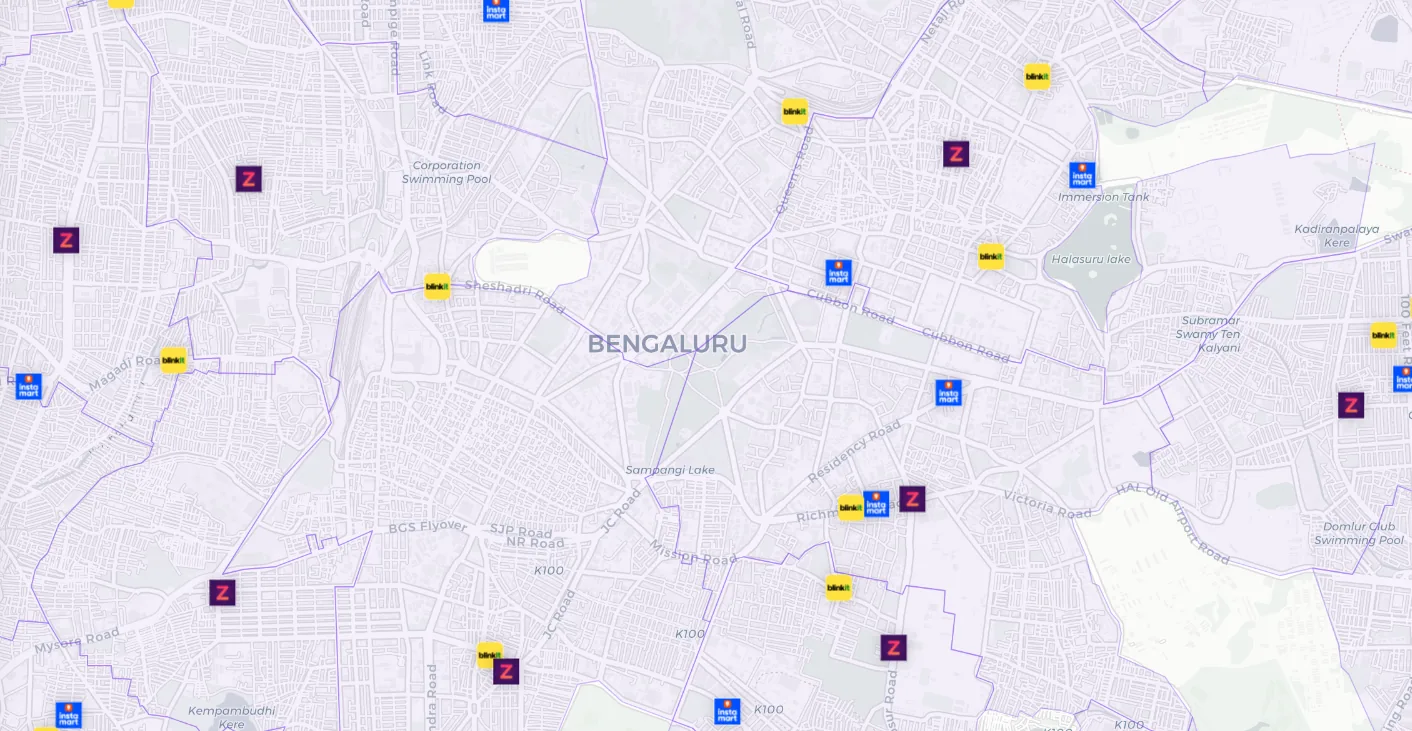
Sometimes one pincode needs several dark stores. By my own count, HSR alone has about 13 dark stores today, three of them Zepto's and three Blinkit's.
Across the city, CLSA counts 735 quick-commerce dark stores, the most of any Indian city. They aren't spread evenly.
Distance is almost always the wrong ruler
In Bangalore, a 2 km trip on one side of a dark store can take 45 minutes, while a 6 km trip on the other side takes 20. It depends on which junctions sit between the store and the customer, and what time of day it is.
That's why the answer to "can you do 30 minutes there?" is often "at what time, and from which direction?". Depending on the chokepoints, a pincode might support 30-min, 60-min or 2-hour SLAs, and the radius isn't a neat circle. Most consumer quick-commerce apps divide geography hexagonally. A 2023 IIT Bombay paper on dark-store planning makes the same point: it defines a store's reach by travel time, not distance.
The last last-mile: gated societies
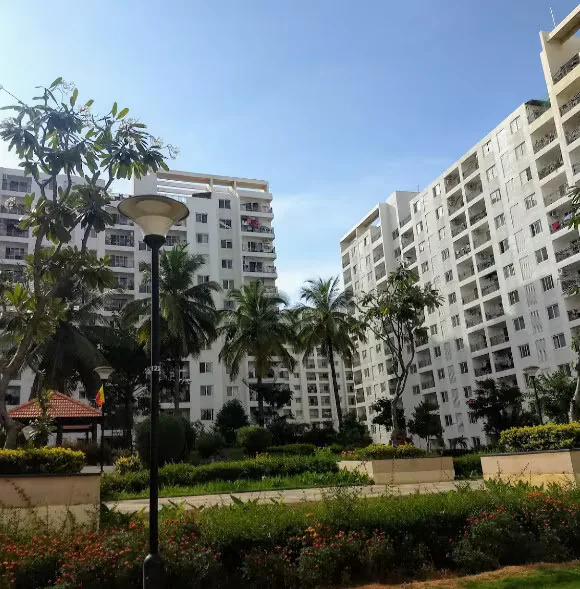
For us, the ORR is the hardest stretch. Part of that is the extreme peak-hour traffic. The other part is gated societies.
What people outside delivery don't see is that the rider often reaches the society gate on time. Then comes the MyGate approval, the walk to the right block, the elevator going up 20 floors, and the wait at the door.
That usually adds ~10 minutes, and it also cuts the orders/hour per rider metric.
We have many stories:
- No approval from the customer, so the rider waits at the gate.
- Approval given, but no one answers the door.
- Riders not allowed inside with their vehicle, which means a 500-metre walk.
- Riders not allowed to use the lifts.
This isn't only our experience. In December 2025, a Bengaluru rider's video of walking several hundred metres inside a gated community started a debate online. I'm sure you have come across a Reel or two showing this as well.
Rain hits specific pockets
Rain doesn't slow the whole city equally either. As of May 2025, Bengaluru had 209 flood-prone spots, and areas with recurring floods include Koramangala, Bellandur and KR Puram. Yelahanka has been especially prone in recent years.
Look at that list again. Some of the busiest demand pockets in the city are also on the recurring flood list.
How it matters for a D2C founder
You don't need a new tool for any of this. You need the right cut of the data you already have.
- Use the delivered time, not the shipped time. Shopify's order export has "Fulfilled at", which is when the order was packed & kept ready for despatch, not when it was delivered. Delivered time comes from your delivery partner's report.
- Look at P90 and P95, by pincode. Not the city average. Find the pincodes where your slowest orders usually emerge.
- Split by weekday and hour. A pincode that fails only on weekday evenings is likely a time-window problem first. Ask how your partner plans around it.
- Mark rain days before you blame anyone. Have a real-time delivery ETA that updates based on local data.
- Ask your delivery partner for pincode-level data. At Zappr, brands get delivery data by pincode on request. Whoever you work with, ask for it, and ask what they see in your weakest pincodes.
When you have that table in front of you, a few questions are worth asking. Which of your pincodes sit on the ORR? Which are full of gated societies? And who, on your side or your partner's, actually knows all this?
If you'd like to look at your own Bangalore pincodes together, you can book a call at zappr.delivery. Our pricing is public too.
Sources
- Bengaluru rises to world's second most congested city in 2025, The News Minute, 23 Jan 2026
- Bengaluru, Kolkata among world's slowest cities, Down To Earth, 27 Jan 2026
- 13.5 km jams and counting: why Bengaluru's ORR firms want road works delayed, The News Minute, 20 Aug 2026
- Predicting delivery times: accurate ETA, Rabbitmart, 15 Jul 2024
- Bengaluru office market, ICRA, 1 Dec 2025
- Bengaluru residential market scales new peak in 2025, Outlook Money, 8 Jan 2026
- Men of the Year 2017: Swiggy founders, MansWorld, 19 Dec 2017
- Swiggy, Elevation Capital
- Swish, Inc42, 19 Nov 2024
- Rapido's food delivery service Ownly, Verdict Foodservice, 14 Aug 2025
- Bengaluru, that claustrophobic feeling, Deccan Chronicle, 12 Jul 2016 (2011 census data)
- Split Bengaluru into five corporations, The News Minute, 20 Jul 2025
- Spatic
- Flipkart Minutes overtakes Swiggy Instamart in dark stores, Outlook Business (PTI, CLSA), 26 Aug 2026
- Dark store placement for quick commerce, IIT Bombay, arXiv, Dec 2023
- Bengaluru Zomato delivery agent's video sparks debate, Storyboard18, 22 Dec 2025
- Bengaluru's infra fails crucial rain test, The News Minute, 20 May 2025
- Exporting orders, Shopify Help Center